Death
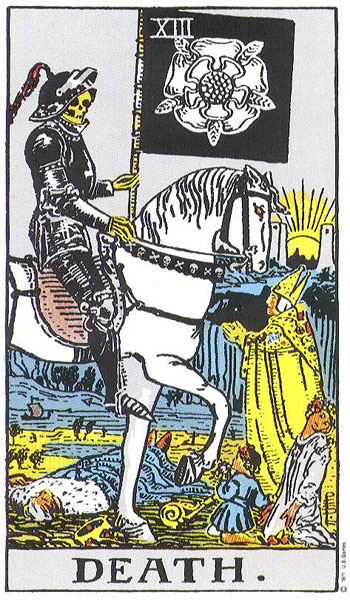
No card is feared more and meant less literally than Death. It rides in not to end a life but to close a chapter, clearing the ground so something truer can grow. To draw it is to be asked to let what is already finished actually finish, and to trust that an ending is also a doorway.
Upright meaning
Upright, Death is transformation through release. It marks the close of one chapter so another can open, and it almost never points to a physical end; what it asks is that you stop propping up something that has run its course. The card carries endings and renewal in the same breath, because one makes room for the other.
This is the deep, irreversible kind of change, the sort you cannot undo and would not want to. Death invites you to let go cleanly, to grieve what is passing without clinging to it, and to recognise that the discomfort of an ending is the cost of the renewal on its far side. Something new is waiting in the cleared space.
Reversed meaning
Reversed, Death suggests you are clutching what has already died. The goodbye keeps getting dragged out, the chapter that should have closed stays open, and the resulting stagnation gets renamed as safety. The card gently points to the thing you are refusing to release.
This reversal often comes down to fear of change, the dread that letting go will leave you with nothing. But holding the dead thing in place is its own slow loss. The reversed card asks you to stop embalming the past and let the natural turn happen, so that life can move again.
At the threshold
At work, Death can mark the end of a role, a project, or an identity you outgrew, and the relief that follows once you admit it is over. In relationships, it is the honest close that makes room for something healthier, sometimes with the same person, sometimes not. In daily life, it favours clearing out what no longer fits, the habit, the obligation, the version of yourself you have outlived. Let it end, and watch what grows.
Symbols on the card
In the Rider-Waite-Smith image a skeleton in black armour rides a white horse across a field, carrying a black banner marked with a white five-petalled rose, the flower of life amid the emblem of death. A bishop, a child, and a fallen king lie before him, none spared by the turning. Yet a sun rises between two towers on the horizon, the promise of a new day on the far side of the ending.
Its I Ching kin
Death is a Water card, and its I Ching kin is Kan ☵ (坎), the trigram of Water. Kan is the dark flowing depth, the river that carries everything downstream and dissolves the old forms it meets; it teaches that letting go is how water keeps moving toward the sea. That suits Death, where release is not loss but passage. To feel where an ending is asking to be honoured, cast a hexagram, and read how tarot and the I Ching rhyme.
Drawing this in a reading? Pull a card. For reflection and insight, not fortune-telling — see our disclaimer.