The Hierophant
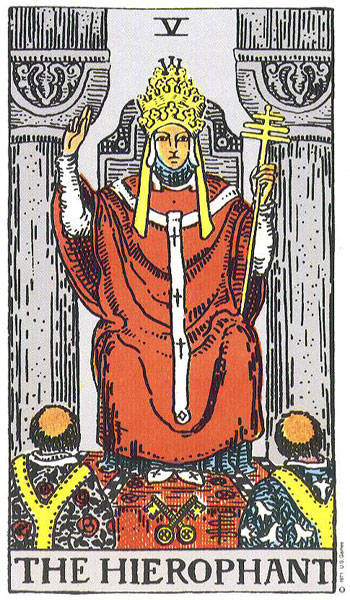
The Hierophant is the keeper of the handed-down, the figure who stands at the front of the room because someone stood there before him and someone will after. He represents tradition, shared belief, and the teachers who carry knowledge across generations. To draw him is to be asked whether this is a moment to learn the established way before you try to reinvent it.
Upright meaning
Upright, the Hierophant points to the value of tested paths and trusted guidance. There is wisdom that has already been worked out, mentors who have walked this ground, institutions and customs that exist because they solved a real problem. The card suggests you steady yourself on that inherited knowledge before you improvise.
This is also the card of mentorship and belonging to something larger than yourself, the apprenticeship, the faith, the lineage, the long tradition you choose to join. Learning from a teacher is not weakness here; it is how skill and meaning get passed forward. Sometimes the most useful thing is to study under someone who has already arrived.
Reversed meaning
Reversed, the Hierophant asks whether you are following a rule because it is true or only because it is familiar. Tradition curdles into dogma the moment no one remembers why it exists, and inherited scripts can outlive their usefulness while still demanding obedience. The card invites you to question what you have simply accepted.
The other reversal is rebellion, sometimes earned and sometimes reflexive. Breaking with convention can be exactly right, but reflexive defiance is just dogma wearing the opposite costume. The reversed Hierophant also warns of hollow ritual, the form kept long after the meaning left it.
In learning and belonging
At work, this card favours finding a mentor, learning the craft properly, and respecting the process before you bend it. In relationships, it touches on commitment, shared values, and the traditions two people decide to keep or to remake. In daily life, the Hierophant is the case for asking someone who already knows, and for choosing which inherited customs still earn their place in your week.
Symbols on the card
In the Rider-Waite-Smith image a robed figure sits between two pillars, hand raised in blessing, with two acolytes kneeling before him to receive the teaching. He wears a triple crown and holds a triple-barred staff, signs of layered authority, and crossed keys lie at his feet, the keys to mysteries he is meant to open for others. The whole scene is one of transmission, knowledge passing from one set of hands to the next.
Its I Ching kin
The Hierophant is an Earth card, and his I Ching kin is Kun ☷ (坤), the trigram of Earth. Kun is the receptive ground that holds and carries, the patient soil in which seeds planted long ago still grow; it is continuity and devotion, the bearing of what was given. That suits the Hierophant, the carrier of tradition who passes the harvest forward. To weigh which inherited path to trust, cast a hexagram, and read how tarot and the I Ching rhyme.
Drawing this in a reading? Pull a card. For reflection and insight, not fortune-telling — see our disclaimer.